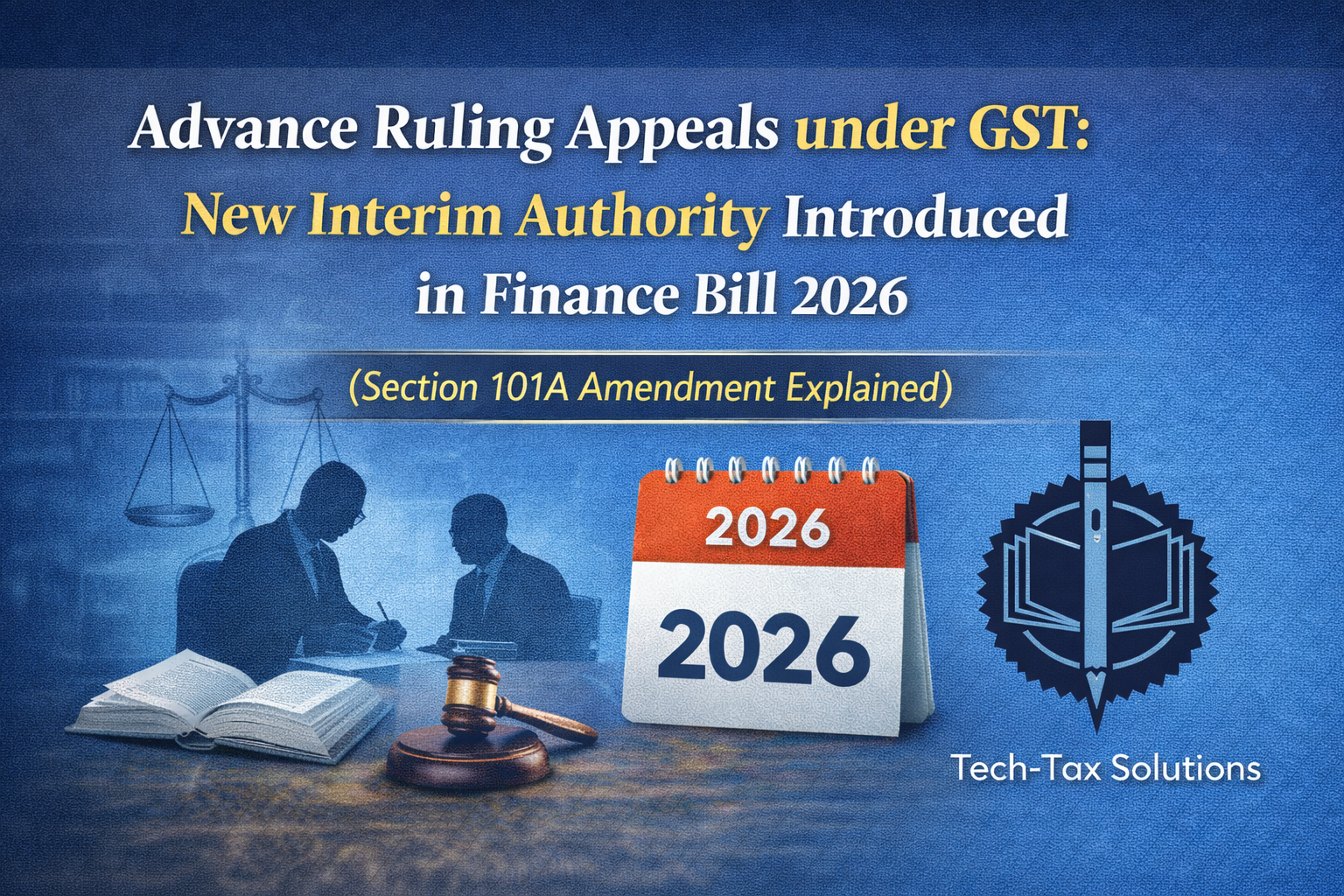
Finance Bill, 2026 introduces a temporary appellate mechanism for GST Advance Rulings till the National Appellate Authority is constituted. Section 101A amended to remove long-standing uncertainty.
📌 Background: The Advance Ruling Vacuum Problem
Under GST law, conflicting Advance Rulings issued by different State AARs created serious challenges for taxpayers operating across multiple States.
Although the law provided for a National Appellate Authority for Advance Ruling (NAAAR) under Section 101A, the Authority was never constituted.
👉 Result:
-
Appeals under Section 101B could not be heard
-
Taxpayers were left without an appellate remedy
-
Legal uncertainty continued for years
The Finance Bill, 2026 finally addresses this gap.
🔁 What Has Changed in Finance Bill 2026?
A new sub-section (1A) has been inserted in Section 101A of the CGST Act, 2017.
This amendment creates a transitional appellate mechanism until the National Appellate Authority is formally constituted.
🟢 Section 101A – Before vs After (Simple Comparison)
Particulars Before Finance Bill 2026 After Finance Bill 2026 National Appellate Authority Provided in law Still not constituted Appeals under Section 101B Practically blocked Now enabled Interim authority ❌ None ✅ Existing authority may be empowered Government power Not available Exercisable on Council recommendation Meaning of authority Not defined Includes Tribunal
| Particulars | Before Finance Bill 2026 | After Finance Bill 2026 |
|---|---|---|
| National Appellate Authority | Provided in law | Still not constituted |
| Appeals under Section 101B | Practically blocked | Now enabled |
| Interim authority | ❌ None | ✅ Existing authority may be empowered |
| Government power | Not available | Exercisable on Council recommendation |
| Meaning of authority | Not defined | Includes Tribunal |
✅ New Legal Position Explained Simply
After Finance Bill 2026:
✔ Government can notify an existing authority
✔ Such authority can hear appeals under Section 101B
✔ Procedural provisions of Section 101A(2)–(13) will not apply
✔ References to “National Appellate Authority” will be deemed references to such empowered authority
This ensures continuity of appellate remedy.
🧠 Who Is Impacted the Most?
This amendment is critical for:
-
Companies operating in multiple States
-
Taxpayers receiving conflicting AARs
-
Businesses relying on advance rulings for structuring
-
Large contracts and classification disputes
If an adverse or conflicting advance ruling affects your business, this change matters.
⚠️ Important Points to Note
❌ This is not a permanent substitute for the National Appellate Authority
❌ Procedural safeguards under Section 101A(2)–(13) do not apply
✔ It is a temporary statutory bridge, not a new tribunal
Taxpayers must watch for notification specifying the empowered authority.
📋 What Should Taxpayers Do Now? (Action Checklist)
✔ Identify pending or potential advance ruling disputes
✔ Track notifications issued under Section 101A(1A)
✔ Prepare appeal documentation proactively
✔ Re-evaluate reliance on existing conflicting rulings
Early preparedness will reduce litigation risk.
❌ Common Mistakes to Avoid
-
Assuming old conflicting rulings automatically stand settled
-
Missing appeal timelines once authority is notified
-
Treating this amendment as optional
Assuming old conflicting rulings automatically stand settled
Missing appeal timelines once authority is notified
Treating this amendment as optional
This provision revives appellate rights — but only if exercised timely.
⚖️ Legal Reference
-
Finance Bill, 2026 – Clause 140
-
Section 101A(1A), CGST Act, 2017 (Inserted)
-
Section 101B, CGST Act, 2017
Finance Bill, 2026 – Clause 140
Section 101A(1A), CGST Act, 2017 (Inserted)
Section 101B, CGST Act, 2017
🏁 Conclusion
The insertion of Section 101A(1A) is a crucial institutional correction under GST law.
By enabling a temporary appellate mechanism, Finance Bill 2026 restores legal certainty for taxpayers stuck with conflicting advance rulings.
This amendment significantly strengthens rule of law and fairness in GST adjudication.
If your business is affected by conflicting or adverse GST advance rulings, it is advisable to evaluate the appellate options emerging under this amendment.